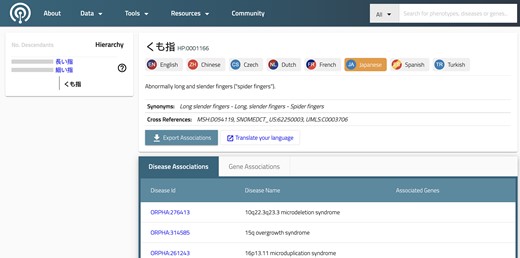
Appearance
Human Phenotype Ontology (HPO)
Ontologies are systematic representations of knowledge that can be used to capture medical phenotype data by providing concepts (terms) from a knowledge domain and additionally specifying formal semantic relations between the concepts. Ontologies enable precise patient classification by supporting the integration and analysis of large amounts of heterogeneous data. The HPO is widely used in human genetics and other fields that care for individuals with rare diseases (RDs) and is also increasingly being used in other settings, such as electronic health records (EHRs). HPO terms are used in the Phenopacket Schema to represent phenotypic features such as signs, symptoms, and laboratory and imaging findings.
Additionally, the HPO project is developing a corpus of phenopackets derived from the published literature that with time will form the backbone of the HPO annotation project (A corpus of GA4GH phenopackets: Case-level phenotyping for genomic diagnostics and discovery).